Age-appropriate chores for kids: a chart from 2 to 15 (and how to make them stick)
What chores kids can do at each age from 2 to 15, what research says about the benefits, and how to get them done without asking ten times.

In this article
“It’s faster if I do it myself.” True: a 6-year-old sets the table slower and worse than you. But every chore they do is one less thing for you to do and remember a few years from now, and one more skill for them.
Here’s a chart of chores by age, what the research says, and how to get them done without asking ten times.
What the research says
- Skills. A La Trobe University study of more than 200 children aged 5 to 13 found that kids who did more self-care and family-care chores (like making their own snack or helping cook for everyone) had better working memory and inhibitory control, two executive functions that matter a lot at school (Tepper, Howell & Bennett, 2022, Australian Occupational Therapy Journal).
- How kids see themselves. A study that followed U.S. children from kindergarten to third grade found that those who did chores more often at 5–6 felt more competent socially and academically, and more satisfied with life, by 8–9 (White, DeBoer & Scharf, 2019, Journal of Developmental & Behavioral Pediatrics).
Both studies show associations, not cause and effect. But they point the same way: chores aren’t just help for you, they’re learning for them.
Chores by age chart
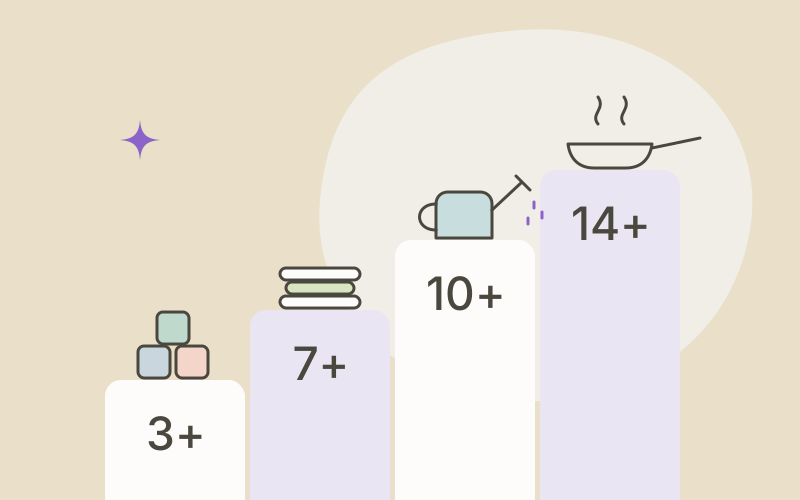
For ages 5 to 12, the chart follows the American Academy of Pediatrics’ suggestions (HealthyChildren.org). The other ages are a rough guide: every kid is different. Each age group can also do everything in the rows above.
| Age | Chores they can usually handle |
|---|---|
| 2–3 | Put toys in a bin, take dirty clothes to the hamper, throw away trash, water a plant with help, carry their plate to the kitchen |
| 4–5 | Set and clear their own place, feed the pet, put shoes away, help unpack groceries, make their bed their way |
| 6–7 | Make the bed, set and clear the table, put away clean clothes, sort laundry by color, empty small trash cans, sweep, pack their backpack with help |
| 8–10 | Vacuum, help make dinner, make their own snack, put away groceries, walk the dog, pack their backpack alone |
| 11–12 | Clean the kitchen, change sheets, unload the dishwasher, wash and fold laundry, clean the bathroom, cook a simple meal with an adult nearby |
| 13–15 | Cook a full meal, do a small grocery run with a list, own their laundry start to finish, watch younger siblings while an adult is home, keep track of their own schedule and appointments |
How to make chores stick (without nagging)
These come from the same AAP guidance and from what works day to day:
- One chore at a time. If they’ve never had chores, start with one. Add the next when the first runs on its own.
- Make it visible. A chart on the fridge or their door: what, which days. It’s a reminder that isn’t you.
- Same time, same order. The routine does the remembering.
- Praise effort, not results. “You made your bed by yourself” matters more than fixing the wrinkle.
- Don’t redo it in front of them. If the bed is lopsided, it’s lopsided. Redo it and they learn their work doesn’t count.
- Calm consequences, not lectures. For example, the tablet comes after the chore, not before.
- Check in as a family now and then. A short talk about what’s working and what to change.
- Don’t drop chores when life gets busy. The AAP calls that a common mistake: busy weeks are when chores help most.
From “helping” to “owning”
Helping
- "Take the trash out when I tell you"
Owning
- "Tuesday and Friday trash is yours"
As kids grow, the goal is to move from single tasks to areas they own, just like adults: not “take the trash out when I tell you,” but “Tuesday and Friday trash is yours.” A teenager can own their laundry, backpack and schedule start to finish. More on that idea in how to split household chores fairly.
In Flia, each family member has a role: a teen aged 13 to 17 can have their own account (with an adult’s consent) and gets notified when a task is assigned to them, while younger kids’ tasks are visible to all the adults. A repeating task, like trash twice a week, is set up once and shows up for whoever owns it.
Key takeaways
If mornings are the hardest part, start there: a school morning routine for kids.
Questions
What chores can a 6-year-old do?
Make their bed, set and clear the table, put away clean clothes, sort laundry by color, sweep, empty small trash cans and pack their backpack with help.
Should kids get paid for chores?
There's no single answer. Many families separate basic chores everyone does because they live in the house from extra jobs that can earn a small reward.
How do I get my kids to do chores without nagging?
Start with one chore, make it visible on a chart, keep it at the same time every day, praise effort, and use calm consequences, like screen time after the chore, instead of repeated reminders.